

Kimberly D.
asked • 01/09/24Solving quadratic equations using the quadratic formula
X^2=4z+1
More
3 Answers By Expert Tutors
Assuming that "z" should be "x", we have:
x2 - 4x - 1 = 0
x = [-(-4) ± √[(-4)2 - 4(1)(-1)] ] / (2(1)) = (4 ± √20) / 2 = [4 ± √((4)(5))]/ 2 = [4 ± 2√5] / 2
= 2(2 ± √5) / 2 = 2 ± √5 = 2 - √5 , 2 + √5
Inactive Tutor answered • 01/10/24
Tutor
New to Wyzant
Great question! First, we must rewrite the equation so that the variables are in order from the largest exponent to the smallest on one side of the equal sign:
- x2 = 4z +1 → x2 - 4z - 1 = 0
Next, we determine which exponent corresponds to which variable in the quadratic equation:
- ax2 + bx + c = 0: general equation
- 1x2 = ax2, so a = 1
- -4z = bx, so b = -4
- -1 = c, so c = -1
Next, we plug each of the three variables into the general quadratic formula:
- x = (-b ± √b2 - 4ac) / 2a
- x = (-(-4) ± √(-4)2 - 4(1)(-1)) / 2(1)
Next, we simplify the equation:
- x = (4 ± √16 - (-4)) / 2
- x = (4 ± √16 + 4) / 2
- x = (4 ± √20) / 2
- x = (4 ± 4.472135955) / 2
- x = (4 + 4.472) / 2 AND x = (4 - 4.472) / 2
- x = 8.472 / 2 AND x = -0.472 / 2
- x = 4.236 AND x = -0.236
In conclusion, the two possible solutions for x are 4.236 and -0.236.
Inactive Tutor answered • 01/09/24
Tutor
New to Wyzant
Hello! For the equation x^2=4x+1, first rearrange it to x^2-4x-1=0
Now according to the quadratic equation ax^2+bx+c=0, we can see that a=1, b=(-4) and c=(-1)
To solve, plug these into the formula
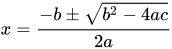
So therefore x=(4+/- square root of 20) / 2
X=4.236 or X=(-0.236)
Still looking for help? Get the right answer, fast.
Ask a question for free
Get a free answer to a quick problem.
Most questions answered within 4 hours.
OR
Find an Online Tutor Now
Choose an expert and meet online. No packages or subscriptions, pay only for the time you need.



Inactive Tutor
Do you mean x^2 = 4x + 1?01/09/24