

Alyssa Z.
asked • 04/20/21Given:In ⊙O, OA = 15, BC = 18, and CD = 12. Find:AABCD in square units
Consider the following figure.
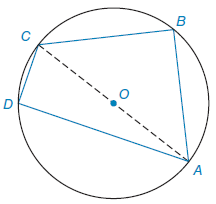 A circle contains a quadrilateral with four labeled vertices, a labeled center point, and a dashed line segment.
- Each vertex of the quadrilateral A B C D is on the circle.
- The first side of the quadrilateral starts at vertex A, goes up and to the left, and ends at vertex B.
- The second side of the quadrilateral starts at vertex B, goes down and to the left, and ends at vertex C.
- The third side of the quadrilateral starts at vertex C, goes down and to the left, and ends at vertex D.
- The fourth side of the quadrilateral starts at vertex D, goes down and to the right, and ends at vertex A.
- The center of the circle is point O.
- A dashed line segment starts at vertex C, goes through the center point O, and ends at vertex A.
Given:In ⊙O, OA = 15, BC = 18, and CD = 12.
Find:AABCD in square units
AABCD =  . units2 . units2
|
More
1 Expert Answer

Because angles B and D intercept semi-circles (180 degrees), their measure is 90 degrees and we have two right triangles. We just need to compute the area of each triangle and add them up.
The hypotenuse of both right triangles is AC whose length is 2 times the radius OA (15) = 30
By the Pythagorean Theorem, AC**2 = CD**12 + AD**2 and since CD = 12 and AC = 30:
30**2 = 12**2 + AD**2
AD = 27.5
Area of right triangle = 1/2 the product of the two legs.
Area of ACD= 1/2 * AD * CD = 1/2 * 27.5 * 12 = 165
By the Pythagorean Theorem, BC**2 + AB**2 = AC**2 and since BC is 18 and AC = 30:
30**2 = 18**2 + AB**2
AB = 24
Area of ABC = 1/2 * 18 * 24 = 216
Sum of areas of triangles is 216 + 165 = 381
Area of ABCD is thus 381
Still looking for help? Get the right answer, fast.
Ask a question for free
Get a free answer to a quick problem.
Most questions answered within 4 hours.
OR
Find an Online Tutor Now
Choose an expert and meet online. No packages or subscriptions, pay only for the time you need.


Alyssa Z.
Please do not just say use this. I am a visual learner and need step by step04/20/21