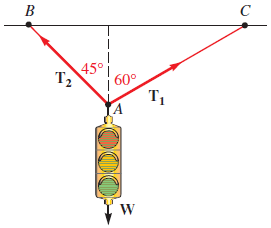

Divide T1 and T2 into their x & y component vectors:
T1x = T1 (sin60) T2x = T2 (sin45)
T1y = T1 (cos60) T2y = T2 (cos45)
Note that the net force in the horizontal (i.e., x) direction is 0, since the traffic light is not accelerating horizontally. Thus,
T1x = T2x
T1 (sin60) = T2 (sin45)
Additionally, the traffic light is not accelerating vertically (i.e., in the y direction), either. There are three forces acting in the y-direction: T1y , T2y , & the force of gravity on the traffic light (i.e., its weight). Since there is no acceleration in the y-direction, the sum of the three forces is 0.
∑Fy = T1y + T2y + (-19 lbs) = 0
T1y + T2y = 19 lbs
T1 (cos60) + T2 (cos45) = 19 lbs
At this point, we have found 2 equations describing the relationship between 2 variables (in bold), so we are ready to begin solving for them.
T1 (sin60) = T2 (sin45) T1 (cos60) + T2 (cos45) = 19 lbs
T1 = T2 (sin45) / (sin60)
T1 = T2 (0.816) T2 (0.816)(cos60) + T2 (cos45) = 19 lbs
T2 (0.408) + T2 (0.707) = 19 lbs
T2 (1.155) = 19 lbs
T2 = 17.04 lbs
Now that we've found T2, we can go back to the first equation and find T1.
T1 = T2 (0.816)
T1 = (17.04 lbs)(0.816)
T1 = 13.90 lbs