


Stanton D. answered • 02/24/21
Tutor to Pique Your Sciences Interest
Hi Taylor H.,
So -- when you look at a chemical formula, what do you see? You should see element symbols, and indicators (subscripts, and sometimes parentheses and leading coefficients) of multiples of elements
So MgSO4 should tell you 1 Mg, 1 S, and 4 O atoms, right?
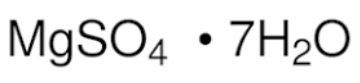
For that hydrate notation, • 5 H2O means 5 molecules of water; water, and sometimes acids and bases are "strung on" in this notation.
When you are talking molecules or moles, you just use the numbers in the chemical formula.
But when you are talking masses (either as starting data, or ending data, or anywhere in between) you must convert to a moles basis in order to do any math within the chemical formula.
So for MgSO4 • 5 H2O, you add up all those atoms' masses (for the water, you figure it once, then multiply by 5). That total is the molar mass of the magnesium sulfate pentahydrate. It has units of (g/mole salf). So therefore, when you start with 80g salt, you divide by your molar mass value you just calculated, ending up with mole salt units. To get the mass of the water in that, you multiply by the coefficient of the water in the salt -- there are 5 molecules water in each molecule of the salt. That step carries implicitly the units of "mole water/mole salt", so that you end up with moles water. Then you multiply by the molar mass of water (~18 g/mole, but you should use all the precision of your periodic table!), and you get mass of water.
When you get better at that, you can directly calculate the molar mass of the hydrate salt and the 5water, and multiply directly from mass salt -> mass water, using the multiplier ratio (molar mass 5water/molar mass hydrated salt).
Tyndall effect is diffraction, as I recall. Either you are driving through fog, and seeing your headlights bounce back at you (it's very disconcerting!), or maybe you are having cataracts in your eye vitreous humor and getting starring, streaking, or halos around bright lights in your field of vision. But light sensations that streak (then disappear) are possibly symptoms of a "sticky" retina; if the eyeball briefly adheres to the retina it can tweak it when you move your eyeball, which mechanically transduces into a brief sensation of light. Also disconcerting, but usually not serious, and temporary. Just sayin'
--Cheers, -- Mr. d.


