


Ryan G. answered • 10/26/20
Math, physics and astronomy tutor
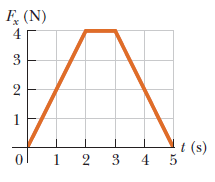
The impulse is just the area under the F vs. t graph. If you look at the graph, it can be split up into two triangles and a rectangle. For the first triangle, the base goes from 0 to 2 sec and the height is measured from 0 N to 4 N. Since the area of a triangle is just 1/2 * base * height, the area of the triangle is 1/2 * 4 * 2 = 4 Ns. This is the same as the triangle that goes from 3 to 5 sec and 0 to 4 N. The last piece is the rectangle in the middle. The base is from 2 to 3 sec and the height is from 0 to 4 N, giving an area of 4 Ns. Adding all of these areas gives 12 Ns.
The impulse is therefore, I = 12 Ns = 12.0 kg m/s
The impulse is equal to the change in momentum, I = Δp = mvf - mvi
In part a, since vi = 0, we have mvf = 12 kg m/s. Solving for vf = 12.0/2.60 = 4.6 m/s
In part b, it is initially traveling in the -x direction with a speed of 1.90 m/s. So, mvf - (-mvi) = mvf + mvi=12.0
Solving for vf = 2.7 m/s


