


Doug C. answered • 10/13/25
Math Tutor with Reputation to make difficult concepts understandable
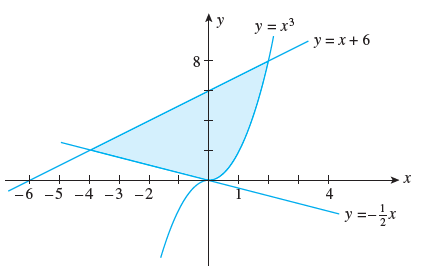
Divide the shaded region into two parts by creating the segment from (0,0) to (0,6). Call the region to the left of that segment R1 and to the right of that segment R2.
The area of R2 can be found using calculus, but also by the fact that that region is triangle with a base equal to 6 and a height equal to 4 (picture the segment from (-4,2) to (0,2) as its altitude. The area of that region is
A1 = (1/2)(6)(4) = 12.
You could also use calculus:
A1= ∫-40 [(x+6) - (-1x/2)]dx = 3/4 x2 + 6x |-40 = -[3/4 (16) + 6(-4)] = -[-12] = 12.
For R2 you will have to use calculus. For each x between 0 and 2 picture a thin rectangle with y-coordinate at the top (x+6) and y-coordinate at the bottom (x3). The height of that rectangle can be represented as (x+6) - x3.
A2 = ∫02[x + 6 - x3]dx = (1/2)x2 + 6x -(1/4)x4 |02 = [(2 + 12 - 4) - (0)] = 10
The total area of the region is: 12 + 10 = 22 square units.



Doug C.
For confirmation visit this graph: desmos.com/calculator/jr9mowpfqe10/13/25