Jeff U. answered • 03/08/22
Tutor
5.0
(52)
Relatable Tutor Specializing in Online AP Calculus AB and Calculus 1
Hey Amelia,
This question may need some clarification, but here's my best shot with what's here.
Remember a Taylor polynomial is of the form:
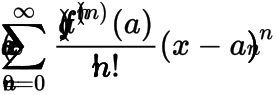
So in our case, the 4th degree polynomial centered at 0 (meaning we use a=0) would look like:
g(0) + g'(0)x + (g''(0)/2!)x2 + (g'''(0)/3!)x3 + (g(4)(0)/4!)x4
What makes this tricky, is that they've defined g in terms of an unknown function f.
But, using the chain rule, if g(x) = f(x2+3), then g'(x) = (f'(x2+3))(2x).
You could find the higher derivatives in terms of f by using chain rule and the product rule. Then try plugging in above.
Hope that helps!