Aaron N. answered • 02/11/22
Experienced Math Tutor and Math Geek
I will outline the method for solving part a, please ask if you need additional help
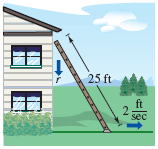
We need a relationship between the variables. Since the ladder forms a right triangle with the building we can use Pythagoras' Theorem
b2 + h2 = 252
Where b is the base of the triangle, the distance of the ladder from the wall
h is the height of the triangle, the distance of the top of the ladder to the ground
By implicitly differentiating this equation, we have the relationships of how fast the base changes given a changing height
2 b (db/dt) + 2 h (dh/dt) = 0
b (db/dt) = - h (dh/dt)
When b = 15, solving the pythagoras theorem gives h = 20. We are given that b is increasing at a rate of 2 ft/sec, (db/dt) = 2 ft/s
These can then be plugged into the above equation to find (dh/dt). Repeat this process for different values of the base of the triangle
For part b and c, use the formulas of the area and angle and apply implicit differentiation. You have all of the variables needed and can plug them in.
(Hint for part c, think of the tangent of the angle)