


William W. answered • 08/29/20
Experienced Tutor and Retired Engineer
Brigitte,
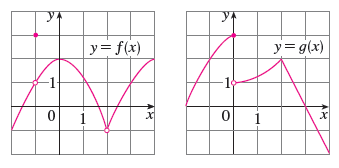
Limits are values (y-values) that the function approaches as you get closer and closer to the x-value in question. For instance, for f(x) as x gets closer and closer to 2 (from the left), then f(x) gets closer and closer to -1 like this:

So these problems all involve finding out what happens to the function value as you get closer and closer to a certain x value. Remember that you never actually get to the x-value, you just get closer and closer to it.
For a) lim x→2 [f(x) + g(x)], as x gets close to 2, f(x) gets close to -1 (from both ways) so the limit is -1 and for g(x), as x gets close to 2, g(x) gets close to 2. So the answer is -1 + 2 = 1
For question b), although f(x) gets close to 2 as x approaches zero, g(x) approaches two different values as x gets close to zero (from the left it gets close to 3 and from the right it gets close to 1) so that limit does not exist (in must approach a single number). So the answer is DNE
Etc
William W.
For e), as x gets closer and closer to 2, f(x) gets closer and closer to -1. Since the limit of a multiplication is the multiplication of the limits, and since the limit as x approaches 2^2 = 4, we can say the limit is 4(-1) = -4. For f), f(-1) = 3. And the limit of g(x) as x approaches -1 is 2, then 3 + 2 = 506/05/21
Mary A.
Thank you!06/05/21



Mary A.
e) lim x→2 [x2f(x)] = ? f) f(−1) + lim x→−1 g(x) = ?06/05/21