Edward C. answered 06/29/20
Caltech Grad for math tutoring: Algebra through Calculus
Since u(x) is a product of functions and v(x) is a quotient of functions, why not use the product rule to find u'(1) and the quotient rule to find v'(5)?

Simon G.
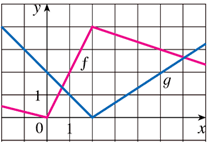
asked 06/29/20If f and g are the functions whose graphs are shown, let u(x) = f(x)g(x) and v(x) = f(x)/g(x).

(a) Find u'(1).
=_______
(b) Find v'(5)
=_______
Edward C. answered 06/29/20
Caltech Grad for math tutoring: Algebra through Calculus
Since u(x) is a product of functions and v(x) is a quotient of functions, why not use the product rule to find u'(1) and the quotient rule to find v'(5)?

William W. answered 06/29/20
Experienced Tutor and Retired Engineer
Because u(x) = f(x)g(x) then (by the product rule, u'(x) = f '(x)g(x) + f(x)g'(x)
Looking at the graph we see that:
f(1) = 2
f '(1) = 2
g(1) = 1
g'(1) = -1
So u'(1) = (2)(1) + (2)(-1) = 2 - 2 = 0
Apply the same logic for v(x). Since v(x) = f(x)/g(x) then v'(x) = [f '(x)g(x) - f(x)g'(x)]/(g(x))2
f(5) = 3
f '(5) = -1/3
g(5) = 2
g'(5) = 1/3
So v'(5) = [(-1/3)(2) - (3)(1/3)]/(2)2 = (-5/3)/4 = -5/12
William W.
You’re right Doug. Thanks.06/30/20
Get a free answer to a quick problem.
Most questions answered within 4 hours.
Choose an expert and meet online. No packages or subscriptions, pay only for the time you need.
Doug C.
Looks like g'(5) = 2/3, i.e. not 1/3. So, -8/12= -2/3.06/29/20