


John W. answered • 07/21/20
High School STEM Tutor
For the sake of clarity here, I'm going to walk through how I would construct the equations for the circles and then answer all of the individual parts, but it's worth noting that some of the later parts will be answered as part of the process of coming up with our equations.
Okay, so the formula for a circle is:
(x - h)2 + (y - j)2 = r2
where the point (h,j) is the center of the circle and r is the radius of the circle. So, in order to construct our equations, we will need to find centers and radii for each of the three circles.
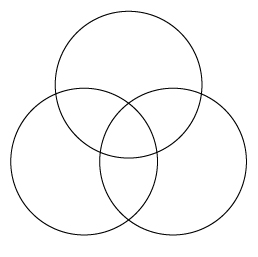
We can see that the circles shown above are all equally spaced apart from one another, and so if we were to connect the circles' centers with lines, we would get an equilateral triangle. So, we should choose centers that form an equilateral triangle. You can choose any points that form an equilateral triangle; I am going to choose (1,0), (-1,0), and (0, √3), and I'm going to label these centers A, B, and C, and I'll label the origin O.
Relevant Side Note: To demonstrate that this is an equilateral triangle, construct the following two right triangles: ACO and BOC. You can see that side AO and BO have length 1, and side CO has length √3. Using the Pythagorean Theorem, we get that the hypotenuses of both triangles (AC and BC) have lengths of 2. The line segment AB also has length 2, and so the triangle ABC must be equilateral.
Now that we have the centers of the circles, we need to choose radii. Looking at the figure above, all the circles have the same radius, and so we just need to find one appropriate radius for all three circles. The circles are far enough apart that they do not intersect each others' centers, and so our radius should be smaller than the distance between the centers of the circles (which is 2, as calculated in the side note). We also know that the circles do intersect each other, and so the radius should be bigger than half the distance between the centers, which is 1. So, we should choose a radius that is greater than 1 but less than 2. Again you can choose anything you want in this range; I'm going to choose √3. So, plugging in our centers and radii, we get the following three equations:
For Circle A: (x - 1)2 + y2 = 3
For Circle B: (x + 1)2 + y2 = 3
For Circle C: x2 + (y - √3)2 = 3
Plugging these equations into an online graphing too, the radius seems a little bigger than the one in the figure. That being said, the problem statement doesn't require a perfect replica, and so these equations should satisfy the problem's requirements.
Now, let's answer the questions:
a) See above
b) Center A: (1,0) Center B: (-1,0) Center C (0,√3)
c) The distance between all three pairs of centers is 2, see the side note earlier for the explanation on that. Alternatively, you can use the Distance Formula to calculate the distances knowing the coordinates in part b. The Distance Formula is d = √( (x2 - x1)2 + (y2 - y1)2 ) where (x1, y1) is one point and (x2, y2) is the other point.
d) We should expect to find two solutions. We can see from the figure and our graph that each pair of circles intersects at two locations, and so choosing two circles and solving the equations should give two possible answers.
e) We should expect to find no solutions. We can see from the figure above and our graph that there are no points where all three circles meet, and so setting all three equations equal to one another shouldn't give any solutions.




Sava D.
07/21/20