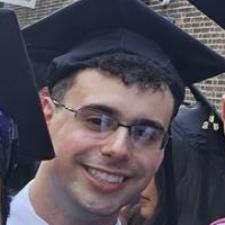
I graduated summa cum laude from the University of Pennsylvania in May 2026 with a B.A. in Biology and minors in Chemistry and Psychology, and I taught organic chemistry there for two years. As a teaching assistant in Penn’s Department of Chemistry, I led weekly recitations for Organic Chemistry I and II with sections of fifteen to twenty undergraduates. At Penn’s Weingarten Center, I ran two-hour weekly workshops for groups of five to twenty, and I tutored the same courses one-on-one. Across...
I graduated summa cum laude from the University of Pennsylvania in May 2026 with a B.A. in Biology and minors in Chemistry and Psychology, and I taught organic chemistry there for two years. As a teaching assistant in Penn’s Department of Chemistry, I led weekly recitations for Organic Chemistry I and II with sections of fifteen to twenty undergraduates. At Penn’s Weingarten Center, I ran two-hour weekly workshops for groups of five to twenty, and I tutored the same courses one-on-one. Across those semesters, I graded midterms and finals for more than three hundred students, well over a thousand exams in all, on rubrics I designed, so I have read a great many partially correct mechanisms and know exactly where points get lost.
My experience shapes how I teach. Organic chemistry punishes rote memorization: there are infinite combinations of reactions and sequences, and exams reward students who can face an unfamiliar situation and reason out what the electrons will do. So I teach the why behind a reaction before the what, because that logic carries you into problems you haven’t seen before. We work problems together rather than you watching me solve them. I ask you to explain your reasoning out loud, and when you get stuck, I look for the specific misunderstanding rather than just reworking the problem. I built more than twenty original slide decks and problem sets while teaching, and I draw on them for practice matched to your course.
I also researched NAD+ metabolism and cellular stress in the Baur Laboratory at Penn’s Perelman School of Medicine, and I am applying to medical school myself, so I know where organic chemistry actually matters downstream for pre-health students. I focus exclusively on Organic Chemistry I and II. I work in person and online, and I ask that you send your syllabus, your last exam, or the problem set you are stuck on beforehand so we spend the hour on what is causing you trouble.