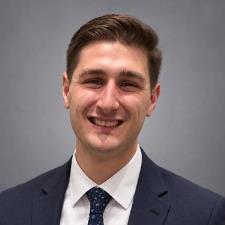
I am a fourth-year medical student, where I have honored every clinical rotation. Before medical school I completed a bachelor's degree in biophysics and spent several years in NIH-funded research, which grounded me in the physics, chemistry, and quantitative reasoning that underlie most of the science curriculum I tutor. I passed USMLE Step 1 on my first attempt and scored a 268 on USMLE Step 2 CK.
I have tutored middle and high school mathematics and sciences for five years — algebra...
I am a fourth-year medical student, where I have honored every clinical rotation. Before medical school I completed a bachelor's degree in biophysics and spent several years in NIH-funded research, which grounded me in the physics, chemistry, and quantitative reasoning that underlie most of the science curriculum I tutor. I passed USMLE Step 1 on my first attempt and scored a 268 on USMLE Step 2 CK.
I have tutored middle and high school mathematics and sciences for five years — algebra through calculus, along with biology, chemistry, and physics — working one on one with students roughly ages eleven through eighteen, both in person and online. For two years I have also tutored the MCAT, mostly with college juniors and seniors and post-baccalaureate students preparing to apply to medical school. Most of this has been paid private tutoring, and I typically keep students across multiple semesters or a full test-prep cycle rather than for single sessions.
My approach emphasizes test-taking strategy as much as content. I start by having a student work through problems out loud so I can hear where the reasoning breaks down, since a missed concept, a misread question stem, poor pacing, and test anxiety each call for a different fix. From there we build content knowledge alongside concrete habits: how to attack a stem before looking at the answer choices, how to eliminate systematically, how to budget time per section, and how to review a practice test so the errors actually change the next one. Having sat these exams myself, I can teach the reasoning the test rewards rather than simply re-explaining the material.