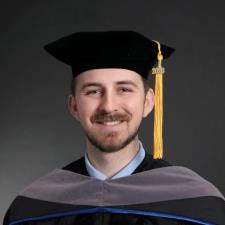
Hi! I'm Caleb, and I graduated Cum Laude from Parker University with my Doctor of Chiropractic (DC) degree. I also earned a bachelor's degree in Anatomy and am currently pursuing a master's degree in Neuroscience because I enjoy continuing to learn about the human body and how it works. During chiropractic school, I discovered that one of the best ways to truly master a subject was by teaching it to someone else. That passion led me to become a peer tutor, where I spent about a year helping...
Hi! I'm Caleb, and I graduated Cum Laude from Parker University with my Doctor of Chiropractic (DC) degree. I also earned a bachelor's degree in Anatomy and am currently pursuing a master's degree in Neuroscience because I enjoy continuing to learn about the human body and how it works. During chiropractic school, I discovered that one of the best ways to truly master a subject was by teaching it to someone else. That passion led me to become a peer tutor, where I spent about a year helping my fellow students in one-on-one sessions, small groups, and the cadaver lab understand anatomy and build confidence in the material.
Most of my tutoring focused on anatomy, including identifying structures, understanding muscle function and innervation, and connecting what students memorized to how the body actually works. My approach is to first figure out where a student's understanding begins to break down instead of immediately jumping into an explanation. I'll ask questions like, "What do you already know?" or "Which part doesn't make sense?" so we can identify the real source of the confusion. Once we have that foundation, I enjoy taking complex topics and breaking them into simple, logical pieces that are easier to understand. I also like to make sessions interactive by having students draw structures, pathways, and relationships themselves. Drawing combines visual learning, active recall, and tactile learning, which helps students retain information much more effectively than passively reviewing notes.
My teaching philosophy is that understanding why something happens is far more valuable than simply memorizing facts. Memorization is still an important part of anatomy and the health sciences, but it becomes much easier when the concepts make sense. For example, if you understand that muscles create movement by contracting, you can begin to reason through where a muscle must attach and what action it performs instead of relying entirely on memorization. My goal is to help students think through problems instead