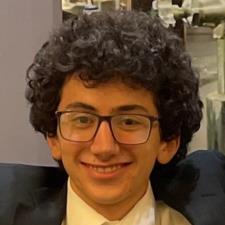
I am a practicing structural engineer in New York City, where I design cast-in-place concrete high-rise buildings. I hold a Bachelor of Science in Civil Engineering from Manhattan University and a Master of Science degree in Civil Engineering and Engineering Mechanics at Columbia University. I am working toward my Professional Engineer license and belong to the American Society of Civil Engineers and the Structural Engineers Association of New York. The mathematics I tutor is not material I...
I am a practicing structural engineer in New York City, where I design cast-in-place concrete high-rise buildings. I hold a Bachelor of Science in Civil Engineering from Manhattan University and a Master of Science degree in Civil Engineering and Engineering Mechanics at Columbia University. I am working toward my Professional Engineer license and belong to the American Society of Civil Engineers and the Structural Engineers Association of New York. The mathematics I tutor is not material I learned once and set aside. I use algebra, trigonometry, and calculus to size beams and columns in buildings that actually get built.
At Manhattan University I was a teaching assistant for the civil engineering department, running laboratory sections for undergraduates. I led groups of college students through experimental procedures, answered questions in real time, and found where their calculations went wrong. I was also selected for the tutoring program run by Chi Epsilon, the civil engineering honor society, through which I tutored college students one on one in Calculus I and II, the same material covered by AP Calculus AB and BC, along with physics. Most were freshmen and sophomores who had done well in high school math but hit a wall when the pace increased, and my job was to rebuild the foundation underneath them rather than get them through the next problem set.
That experience shapes how I tutor now. I start by finding where the breakdown actually is, which is usually two or three topics below where the student thinks the problem is. A student struggling with derivatives is often really struggling with factoring or function notation, and patching the surface problem does not hold. I work through problems alongside the student instead of lecturing and give them a procedure they can repeat on their own.