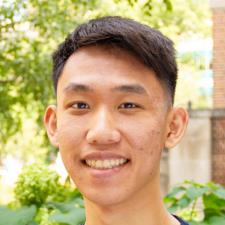
Hello! My name is Julien Sun. I am currently a master's graduate student in mathematics at the University of Minnesota Twin Cities, and I received my bachelor's degree in mathematics from the University of California, San Diego. I'm not highly experienced with tutoring, but the few students that I have taught in algebra and calculus so far have been very successful. I believe this success is due to my approach to teaching, which emphasizes true understanding and problem-solving strategies,...
Hello! My name is Julien Sun. I am currently a master's graduate student in mathematics at the University of Minnesota Twin Cities, and I received my bachelor's degree in mathematics from the University of California, San Diego. I'm not highly experienced with tutoring, but the few students that I have taught in algebra and calculus so far have been very successful. I believe this success is due to my approach to teaching, which emphasizes true understanding and problem-solving strategies, rather than rote memorization of rules and formulas.
For most of my education, my experience with math was that I was told what formula to use in what situation, and then I would do it. My grades were very high because I was good at memorizing, but I hated math because memorization was so boring. When I got to calculus, I was lucky enough to have a teacher that showed me that far more depth to this field than I had thought. It turns out that all those formulas I had memorized had reasons for being like that, and when I understood those reasons, I saw how everything was connected together into a unified theory leading to a single goal, and I also began to appreciate how clever these mathematicians who created these theories were.
When I teach, I want to give this same experience to my students. So, I try to avoid lecturing about math, instead preferring to have them explain things to me. This lets me see where the gaps in their understanding are so I can tailor my explanation to their situation. I also find that this helps students to organize their thoughts and encourages them to avoid feeling bad about mistakes, which is good because making mistakes is an essential part of mathematics. In general, I focus less on how to do procedures and more on why we are doing it because the procedure then follows naturally. The result is that the student feels like they discovered the concepts rather than just being told about them.
I am quite confident in this approach, so please reach out if you're interested.