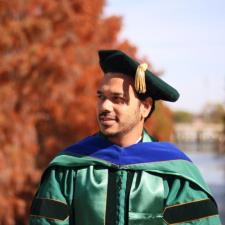
Hello! I am a Mechanical Engineering Ph.D. and a current college faculty member at Maine Maritime Academy. I have taught students since 2014 in Math Olympiad enrichment programs, classroom settings, and undergraduate engineering courses. I have worked with school-age students preparing for advanced mathematics competitions and college students studying mechanics and engineering. I earned both my M.S. and Ph.D. in Mechanical Engineering from Baylor University with a 4.00 GPA in each program,...
Hello! I am a Mechanical Engineering Ph.D. and a current college faculty member at Maine Maritime Academy. I have taught students since 2014 in Math Olympiad enrichment programs, classroom settings, and undergraduate engineering courses. I have worked with school-age students preparing for advanced mathematics competitions and college students studying mechanics and engineering. I earned both my M.S. and Ph.D. in Mechanical Engineering from Baylor University with a 4.00 GPA in each program, and I scored 165 on the GRE Quantitative Reasoning section. I currently teach Mechanics I: Statics and previously served as a graduate teaching assistant for Strength of Materials.
I specialize in quantitative test preparation, mathematics, physics, and mechanical engineering. For GRE and GMAT quantitative preparation and ACT Math, I can help with arithmetic, algebra, geometry, trigonometry, data analysis, word problems, pacing, and test-taking strategies. I also tutor mathematics from algebra through Calculus III, differential equations, and linear algebra, along with introductory statistics and university physics. In engineering, I can assist with statics, dynamics, mechanics of materials, strength of materials, and materials science. I also use MATLAB for numerical calculations, data analysis, plotting, and engineering applications.
My tutoring approach is patient, organized, and focused on genuine understanding. I first identify the concept or step causing difficulty, explain it clearly, and then guide the student through related problems until the method becomes familiar. Instead of asking students to memorize equations, I help them understand what each equation means, when it applies, and how to check whether an answer is reasonable. Students are welcome to share their course, topic, notes, or practice materials before a lesson so we can use our time efficiently. I guide students through their own work and do not complete exams or graded assignments for them.