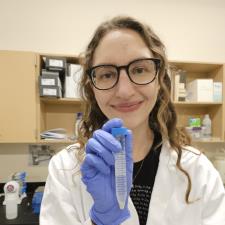
My name is Lauren. I am a geologist and astrobiologist (like Ryland Grace from Project Hail Mary!) with a B.S. in geology and minor in astrobiology from Rensselaer Polytechnic Institute, and I’m currently finishing up an M.S. in Geology from the University of Utah. In between my degrees, I worked as a data analyst at the U.S. EPA. I’ve spent most of my career in a lab, and my academic specialties and passions include Earth sciences, chemistry, astronomy, math, and related subjects.
I have...
My name is Lauren. I am a geologist and astrobiologist (like Ryland Grace from Project Hail Mary!) with a B.S. in geology and minor in astrobiology from Rensselaer Polytechnic Institute, and I’m currently finishing up an M.S. in Geology from the University of Utah. In between my degrees, I worked as a data analyst at the U.S. EPA. I’ve spent most of my career in a lab, and my academic specialties and passions include Earth sciences, chemistry, astronomy, math, and related subjects.
I have served as both an undergraduate and graduate teaching assistant in advanced geology and astronomy courses, where I taught labs, assisted students with labs and homework assignments, and held office hours where I could work with them one-on-one when needed. I have also worked as a science communicator for the Utah Museum of Natural History, where I gave Science Café talks and created hands-on demonstrations in geology, climate change, and planetary sciences.
I was fortunate enough to receive a Montessori education through most of elementary school, after which I moved to a more traditional education. I struggled significantly with this transition academically, particularly in math and science, as I found the-lecture-style teaching method was not intuitive to me. I later realized I would have benefited from an individual tutor, who could have better translated seemingly abstract concepts into real-life applications.
I strongly believe in learning by doing, which is why I have spent most of my academic career doing research alongside my classes. Even the most basic scientific and mathematical concepts can be quite difficult to understand in a vacuum, and spending time on them outside the classroom can make them easier to understand and hold on to. When teaching students, I prefer to build on their existing knowledge, find creative applications for new information, and ensure they have plenty of opportunity to practice new materials.