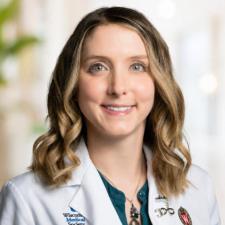
I am an MD/PhD student at the University of Wisconsin-Madison pursuing a PhD in Biomedical Data Science. I earned bachelor's degrees in Biomedical Engineering and Applied Mathematics & Statistics and a master's degree in Biomedical Engineering from Johns Hopkins University. My engineering training included mechanics, electricity and magnetism, thermodynamics, fluid mechanics, mathematics, and quantitative modeling. I scored a 521 on the MCAT and have completed both the premedical science...
I am an MD/PhD student at the University of Wisconsin-Madison pursuing a PhD in Biomedical Data Science. I earned bachelor's degrees in Biomedical Engineering and Applied Mathematics & Statistics and a master's degree in Biomedical Engineering from Johns Hopkins University. My engineering training included mechanics, electricity and magnetism, thermodynamics, fluid mechanics, mathematics, and quantitative modeling. I scored a 521 on the MCAT and have completed both the premedical science curriculum and medical school coursework. I have tutored the MCAT for two years and worked with over 20 students, all of whom scored above 510, with most scoring 515+ and several 520+. I particularly enjoy working with neurodivergent students and adapting instruction to students who may not thrive with traditional teaching approaches.
My data science and AI expertise comes from graduate training, research, and professional experience. Before my MD/PhD, I worked as a data scientist and in medical-device R&D, applying programming, statistics, machine learning, and computational methods to real-world problems. My current PhD research focuses on biomedical AI, including deep learning, large language models, medical imaging, and multimodal clinical data. I regularly use Python, PyTorch, statistical modeling, and machine learning and have completed graduate coursework in machine learning, foundation models, LLMs, and Bayesian statistics.
I have extensive one-on-one tutoring experience with high school, undergraduate, graduate, and premedical students in MCAT preparation, physics, mathematics, statistics, programming, and data science. My approach emphasizes conceptual understanding, breaking complex problems into manageable steps, and identifying the reasoning or knowledge gaps behind errors. For MCAT students, I integrate content review with passage analysis, test-taking strategy, error analysis, and individualized study planning.