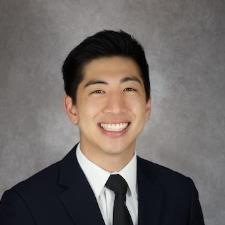
Justin Abe is a Doctor of Medicine candidate at the John A. Burns School of Medicine (expected May 2026) where he is part of the prestigious Alpha Omega Alpha honor society and the Gold Humanism Honor Society. He earned his B.S. in Human Biology from the University of Southern California, graduating summa cum laude with double minors in Psychology and Health Care Studies.
Justin’s teaching experience spans classroom instruction, small-group facilitation, and one-on-one tutoring. At USC, he...
Justin Abe is a Doctor of Medicine candidate at the John A. Burns School of Medicine (expected May 2026) where he is part of the prestigious Alpha Omega Alpha honor society and the Gold Humanism Honor Society. He earned his B.S. in Human Biology from the University of Southern California, graduating summa cum laude with double minors in Psychology and Health Care Studies.
Justin’s teaching experience spans classroom instruction, small-group facilitation, and one-on-one tutoring. At USC, he served as a Supplemental Instructor for Anatomy, where he designed and led review sessions for over 100 students, helping break down complex anatomical concepts into structured, high-yield frameworks. He was also a professor-recommended tutor for cell biology, physics, chemistry, and biochemistry, providing individualized academic support to undergraduate students. Most recently, through Paer Tutoring, he delivered personalized one-on-one instruction in biology, chemistry, and algebra to high school students. In medical school, Justin founded Students4Students, an organization in which medical students host physiology review sessions for college learners. Additionally, he has organized and led multiple workshops and review sessions for first-year medical students and mentored 7 pre-medical students through mock interviews and application support.
Across these roles, which span more than five years, Justin has worked primarily with high school, college, and early medical students in both formal academic and volunteer settings. His goal in teaching is to create a supportive learning environment, tailor sessions to students’ learning styles, and teach students to utilize humorous mnemonics and elaborative encoding rather than rote memorization.