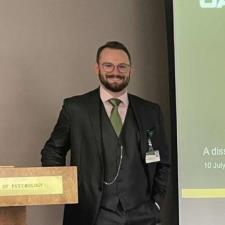
I am a Ph.D. behavioral neuroscientist and experienced college instructor with a passion for helping students build real confidence in statistics, psychology, and research methods, and academic writing. I earned my Ph.D. in Behavioral Neuroscience from the University of Alabama at Birmingham, awarded through the Department of Psychology, along with a Graduate Certificate in Social & Behavioral Statistics and a M.A. in Psychology, and a B.S. in Psychology, Cum Laude, from Kennesaw State...
I am a Ph.D. behavioral neuroscientist and experienced college instructor with a passion for helping students build real confidence in statistics, psychology, and research methods, and academic writing. I earned my Ph.D. in Behavioral Neuroscience from the University of Alabama at Birmingham, awarded through the Department of Psychology, along with a Graduate Certificate in Social & Behavioral Statistics and a M.A. in Psychology, and a B.S. in Psychology, Cum Laude, from Kennesaw State University.
I served as Instructor of Record for ten sections of an undergraduate statistics laboratory course, independently designing and delivering hands-on training in statistical concepts and software to students who often came in feeling anxious about math. Many of these sections were taught remotely during the COVID-19 pandemic. I also spent years as a graduate teaching assistant across statistics, research methods, and psychology courses, and mentored first-year students navigating challenging coursework and research work in behavioral neuroscience.
My research spans clinical rehabilitation psychology, human neuroscience and neuroimaging, and quantitative methods. I have used functional MRI, MEG, and EEG to study memory, cognitive function, and visual processing, developed and evaluated behavioral interventions for cognitive rehabilitation after stroke and long COVID, implemented exercise interventions for people with epilepsy, and analyzed data using R, MATLAB, SAS, Stata, and SPSS. This gives me a strong foundation not just in statistics itself, but in how it is actually used in real psychological and neuroscience research. I find real examples help students understand why a concept matters, and not just how to compute it.
Whether you are working through introductory statistics, research methods, or experimental design, a psychology course, or trying to understand a concept in human neuroscience, I focus on meeting you where you are, breaking ideas down clearly, and building the kind of understanding that sticks.